

Safe observation methods
Despite its awe-inspiring nature, a total solar eclipse must be viewed with extreme caution. Staring directly at the Sun without proper protection can cause severe, irreversible eye damage.
This risk exists before and after totality, as well as in areas where the eclipse is only partial (such as Barcelona and Girona). For this reason, always use certified, safe observation methods.
To enjoy the spectacle in a safe manner, there are various options available. The most common are solar filter glasses, which must be certified to ISO 12312-2 standards.

Glasses with certified solar filters.
Indirect methods are also effective, such as telescopes with proper solar filters or the simple pinhole projector: a small hole in a cardboard box or sheet that projects the Sun’s image onto a surface, allowing risk-free viewing.
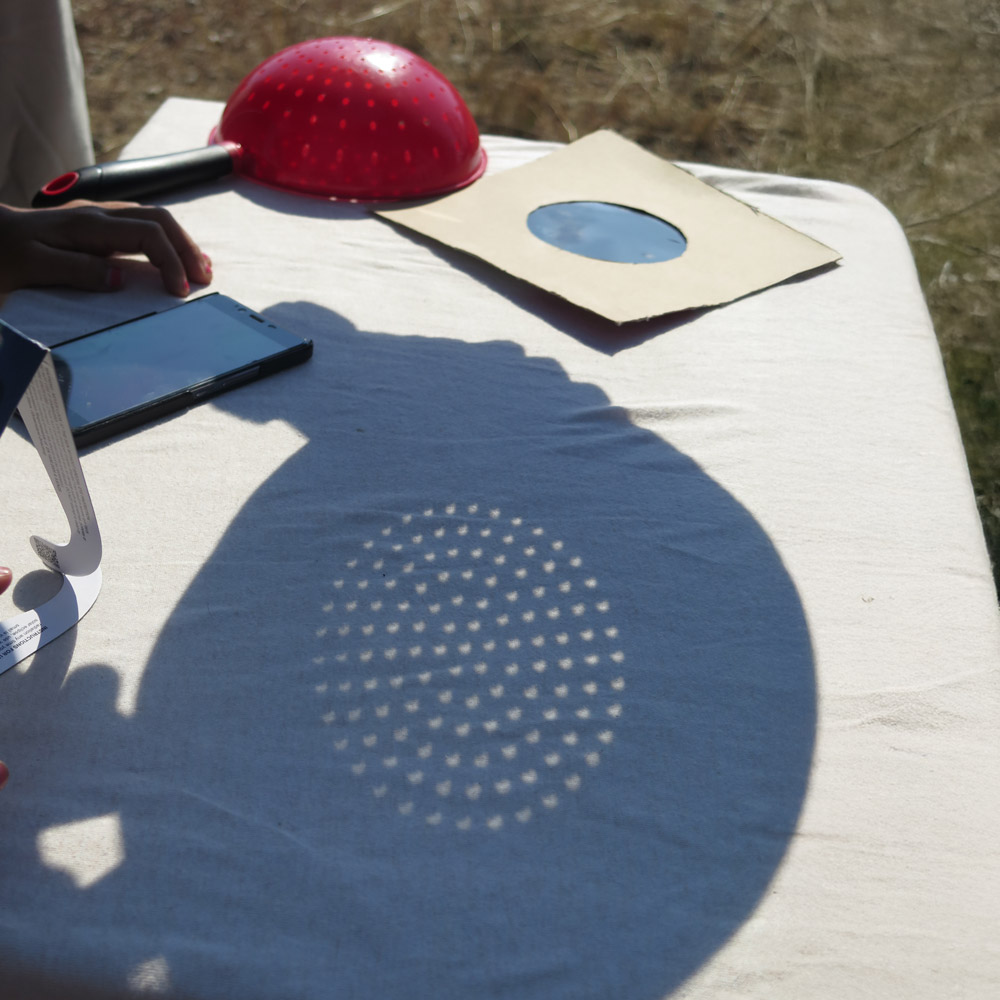
Example of a pinhole projector. Source: IEEC (E. Masana).
During totality – and only then – observe the eclipse with the naked eye, as protective glasses would block the solar corona, stars, and planets. Resume using protection as soon as the first sunlight reappears behind the Moon.
AVOID these UNSAFE methods at all costs:
Sunglasses
Exposed analogue film negatives
X-rays (even through dark areas)
CDs
Any method not confirmed as 100% safe
Never view the Sun through optical instruments (cameras, binoculars, etc.) without a proper filter placed in front of the lens.
Tips for enjoying the eclipse
A solar eclipse is a once-in-a-lifetime astronomical event in Catalonia, unseen since 1905. Thousands are expected to travel for it, especially to southern regions in the path of totality. To ensure that the experience is both safe and enjoyable, we are sharing some tips that may prove useful:
Plan your travel ahead of time
Roads to the south will be crowded, particularly in the hours before the eclipse. Arrive at your spot well in advance – ideally days early – to avoid missing the peak moment.
Confirm visibility at your observation point
The Sun will be very low on the horizon (under 5 degrees). Check in advance for obstructions like mountains, buildings, or trees.
Respect guidelines and the natural environment
Many sites will be in mountainous or forested areas. Avoid starting fires and follow Rural Agents’ and authorities’ rules to minimise fire risks.
Find a shaded spot for waiting
Though totality lasts just 1 minute and 30 seconds, the wait will be long in mid-August heat. A shaded area will allow you to enjoy the experience with greater comfort.
Observe and photograph safely
It is essential not to look at the eclipse with the naked eye during the partial phase: always use certified glasses designed specifically for this phenomenon. For binoculars, telescopes, or cameras, ensure approved solar filters are securely in place to protect your eyes and equipment sensors.
Bring water and basic supplies
August heat and long waits call for good hydration. Pack food if you’ll be there all afternoon.
Don’t leave immediately after the eclipse
Global eclipse experiences show traffic jams peak during departures. Stay a little longer to avoid congestion.
Note that the Perseids meteor shower peaks on the night of August 12. Consider watching it from your eclipse site and heading home later to bypass peak traffic.

Photo: IEEC (E. Masana).